
There’s plenty of compelling YouTube stats floating about regarding its use, its reach, and its benefits to search. It’s quite obvious that it can be an important marketing channel with lots of opportunity, if approached right. So what is the right approach?
As with most things in our industry, there is never one clean-cut answer… That would be way too easy, right?! However, there are plenty of lessons to share regarding what has worked well and what hasn’t. In my opinion, simply using YouTube as a dumping ground for every single video your company produces is a misguided approach. To get the most benefit out of any marketing channel, you need to play to its strengths.
With that, here’s five steps to help you get the most out of your YouTube videos.
1. Figure out how to enchant people
Last week, I read an article by Greg Jarboe about Creating YouTube Ads Worth Spreading. I recommend reading it if you haven’t already (but come back when you’re done!). One part in particular stood out for me which supported my views on playing to a channel’s strength. In YouTube’s case, enchantment plays a big role.
As pointed out by Greg:
“…video content that can enchant people must provide intrinsic value to your viewers. This can come in one of four forms:
- Inspiration– “YouTube has brought to light thousands of inspiring stories of courage and bravery”
- Entertainment– “Some videos are plain-and-simple guffawingly funny”
- Enlightenment– “These are documentaries similar to what you’d see on PBS or the Discovery Channel”
- Education – “Educational videos show how to do things”
This provides the ideal starting point when planning and developing your YouTube approach; to me it forms the backbone. I would argue that for most companies looking to develop videos for YouTube, Education will most likely take the leading form of enchantment where content is concerned. But of course, we can’t rule out Entertainment or Inspiration either.
2. Develop the content that people are looking for
The second step is to figure out what content are people looking for, that would translate well into video format. This step is absolutely key.
Going with an educational video example, there’s plenty of ways to get this information:
- What are the most highly searched for learn-related queries? Phrases like “what is…”, “how to…”, “learn about…”, “tutorial on…” all provide a good starting point.
- What are the most common questions your sales, service and support people receive?
- What are the most viewed FAQ’s on your site?
This should provide you with a healthy list of video topics to focus on. It’s often good to prioritize the highest volume search phrases first. This is the point that you optimize your video to high heaven, developing your video to specifically address that topic and integrating the search phrase throughout the script.
I’ve found that YouTube content that was built based on a pre-defined customer need heavily outperformed content that had already been produced and then retrofitted to try to match a need after the fact. I tested two videos and compared them over a three-week time period. One was developed to address a popular search phrase from the outset. The other was retrofitted to a popular search phrase after it had already been produced. Both had no other “promotion” to drive people to the video, other than search optimization.
Compared to the video that was retrofitted, the video that was optimized from the outset had:
- Six times more views
- Five times more likes
- Double the comments
- Ranked 15 positions higher
3. Lose the stuffy, corporate facade
Now don’t get me wrong. There’s a time and a place for company-branded animated PowerPoints and scripted monotone explanations. YouTube is not that place.
And that’s why we love YouTube. Good YouTube videos don’t have to be a high-production glitzfest. The more real and personal (warts and all), the better. That’s not to say that it should be all Blair Witch Project camera action, or devoid of all brand elements to the point that it looks like a completely independent third-party endorsement of your own company. The trick is finding that balance, and testing that balance to get it just right.
4. Ask for comments and feedback during the video
Applying traditional search optimization for video is a great place to start, but it will only get you so far. Ranking the highest when it comes to video requires doing well in social factors as well. The more people who like, share/embed and comment on your video, all seem to contribute to getting your video to the top. And of course it always helps to get more people to view your video in order to get more people to interact.
So throughout your video make sure you encourage interaction. Ask people to leave questions or comments, subscribe to the channel, or even provide a video response. Always remember that social media isn’t about shouting, it’s about interacting.
5. Promote
As mentioned, getting more people to watch your video helps to drive the view numbers, which helps to get people talking and sharing your video, which helps to drive more even more view numbers, and so forth. It’s all circular.
There’s a number of ways you can promote your video, be it sending out Emails, sharing through social media channels, promoting it on your website… One particular way I’ve seen strong, sustained results has been through YouTube Promoted Videos.
YouTube Promoted Videos is like doing PPC inside YouTube. It’s a really nice way to complement your SEO efforts and help to get even more people to your video.
With YouTube Promoted Videos you get to appear in the search results for your chosen keywords, as well as in the related/suggested videos list. Showing up in related videos is a really nice feature that speaks well to a typical YouTuber’s behavior of watching several videos at a time, in a given session.
The trick of course is keeping people on your video and trying to get them back to your site (or at least somewhere where there’s less distraction!), before they hop off to a video about dancing cats. And that’s the added benefit of promoted videos on YouTube. YouTube Promoted Videos also opens up the option of overlay ads within your video, that can take people back to your site. Don’t just take people back to your homepage though. Try and find a page related to your video’s topic where they can learn more or show them in even more detail, how to do that particular thing.
The Experts
Finally, a couple of recommendations of people who know their YouTube stuff. Greg Jarboe is of course a fountain of video marketing knowledge, and a fantastic speaker on the subject. And also Manny Rivas — I read a ton of his posts when researching for our YouTube efforts. Make sure you check them out.
It all started with a tweet…

That was two years ago. I got a response from Logan who told me to go for it, along with a link to an article about blogging tips. And with that, I was on my way.
When I started out, I wasn’t quite sure the reasons why I was doing it. There were no ulterior motives. All I knew was that this was something I wanted to try. For those who know me, this is not like me at all. For the most part, I’m not very spontaneous and will (or at least attempt to) plan for everything, much to the annoyance of the people around me.
So looking back on these past two years, what have I learned from the blogging experience?
1. Make time
Blogging is like going to the gym. At first, it can feel like a real chore; just one more thing you’d rather not be doing on your evenings or weekends. Unfortunately, blogging doesn’t happen by itself, you have to make time. There’s often a whole host of excuses reasons why you can’t write after working all day long, particularly when you first start out, or following a few weeks of blogger’s block. After a while though, you start to build momentum and it becomes just another part of your routine. Everyone leads a busy life. It comes down to making time for what’s important, be it blogging or otherwise.
2. Get it, by doing it
If your role requires you to get others within your organization to blog, you’re in a much better position to understand time commitments and ways to make the process easier through article planning, finding topic opportunities, or just giving them space to find inspiration, because you’ve been there too. Like most things in life, empathy is key. You can’t preach without having done it yourself.
3. Stay fresh
Blogging keeps your mind fresh. You find yourself a lot more up to date, aware of interesting discussions, information and perspectives on different subjects. It’s a great way to help you stop, step back and reflect on lessons learned, and challenge existing ways of thinking.
4. Points mean prizes
In addition to giving me a lazy cut and paste answer to the same old questions, blogging can often bring along some unexpected benefits. For me, it has provided me with experience to embark on other guest blogging pursuits and win free conference tickets. Score!
5. Get the bad guys
Sometimes it’s possible to use your blog to fight for the greater good. I don’t do this often (only once to be exact) because I don’t condone the whole “angry blogger” mentality. But of all the posts I’ve written over the past two years, it’s satisfying to see that this was the most read. I got a lot of support, particularly from the wonderful Tim Biden who worked his magic to get links into the post to help raise awareness of the bad guys.
There’s been a lot of talk and excitement around Google+ lately. There’s plenty of information out there about Google+ and how to use it, but what are the possible implications for businesses and what questions should search marketers be asking? Here’s my take on it.
Quickly, what is Google+?
Google+ is a new social platform; Google’s newest plunge in the social media space. When people have asked me what it’s like, I’ve described it as Twitter (without the character limit) in a Facebook interface.
Rather than friend people (like Facebook), you simply follow people (like Twitter) by grouping them into circles of friends. You define what these circles are, depending upon your own social circles. This makes it really easy to see and share information depending on your different social circles. For example, my non-search marketing friends no longer have to see articles about black hat PPC techniques (their loss!). Whilst my work colleagues don’t have to see pictures of me stuffing my face with ribs (unless they really, really want to).
In addition to Circles, Google+ have a bunch of other stuff going on like Sparks (content based on interests), Hangouts (video chat), and Huddles (group messaging).
After the anti-climax that was Wave and Buzz, has Google finally gotten social right? So far, Google+ has over 10 million users with over 1 billion items shared a day… and it’s still only in beta to a “limited audience”. The question remains, is Facebook set to become the next MySpace?
How do I set up a Business Profile?
Whoa there cowboy! Businesses have been told not to set up company profiles under personal usernames, but to hold out for specific Google+ business profiles which are coming and will bring with it deep analytics and the ability to connect the business profile with AdWords. Despite this, several companies have anyway (the rebels!), including Ford, Mashable and Search Engine Land.
So what does this mean for businesses?
1. The AdWords connection
Google+ opens up a whole new revenue source for Google (but of course!) by giving advertisers the option to extend AdWords beyond traditional Google search, onto the Google+ social ad network. Afterall, Facebook’s ad revenue hit $2B last year. Why shouldn’t Google want a piece of this too? But with this comes questions for search marketers, including:
- Will Google use social data in Google+ to serve up relevant paid search ads?
- Will social relevance be used to set different cost per click levels by advertiser?
- Will social relevance also have an influence on ad position?
- Will social targeting be utilized to supplement keyword targeting?
2. Impact on SEO
With direct access to all this additional social data, you’d be naive to think that Google aren’t going to get evil with it. You can also bet they’ll use it to determine future SEO rank through social relevance.
For a long time, linking has been used to determine page popularity and relevance; it has been the major factor in influencing rank. Social connections, influencers, sharing and preference (through +1s) is the next logical progression. We’ve already seen studies on how social sharing and preference on Facebook and Twitter has been correlated with rank. Now that Google has their own social firehose, watch out.
Now more than ever, it’s time to make social media a part of your website and ensure the content on your site is highly sharable. Make it easy for your visitors to share and push your content across their social graph. Just like Link Farms before them, expect to see more Like Farms, Tweet Farms, +1 Farms, Re-sharing Farms and people trying to game the social search system.
3. The application of Circles
Circles is a central feature of Google+ and has some interesting possibilities, one being customer segmentation and the ability for companies to better target messaging, testing and research through different circles. This can be particularly useful for larger enterprise companies with different divisions or distinct customer groups. Theoretically they can maintain a single company profile (instead of several) with messaging and interaction targeted accordingly.
There’s also networking and recruiting opportunities through circle connections, perhaps encroaching on LinkedIn territory, particularly when you couple this with impending Business Profiles, Hangouts and Huddles.
What other ways do you think Google+ will impact businesses and search marketing?
More Useful Resources
A recent conversation got me thinking about companies who have been a little shy to dip their toes into social media. In particular, companies who have a corporate website and a corporate presence on a few social media networks, but on their site they almost ignore the fact that they have a presence on these networks, like it’s some kind of dirty secret. It’s a bit of a shame really, and a wasted opportunity.
So what simple steps can be taken to help bridge the gap, and what benefits can it provide? I see three distinct areas to help get these sites started in the right direction:
1. Encourage Followers
If your company has a presence in social media (such as Facebook, Twitter, YouTube, and the like), then simply letting your website visitors know that you are out there can help increase your following.
The fact that these people are on your site to begin with is a good indication that they are the kind of people you want to have following you and having conversations with. So make sure, at a minimum, that this is present on your homepage, but ideally have a dedicated area on all your pages.
If you haven’t already, make sure you check out the new Twitter instant follow button which makes it even easier for visitors to become a follower.
2. Promote Sharing
Sharing of content is important, particularly when it comes to SEO. As we know, getting links is no easy feat, so encouraging your visitors to do just that is a really nice way to help you build up link juice. This can include:
- Sharing content through social networks (EG: Share on Facebook, Tweet This, Stumbleupon…)
- Linking through a simple “Link to this” / “Embed” approach that provides visitors with the code necessary to share content on their own sites
What’s important is to make it really easy for your visitors to share content, particularly on those pages that cover things like news stories, videos and other interesting educational content. So make sure those social sharing buttons have the prominence they need on the content that matters.
3. Provide Preference
There’s been a number of correlation studies done recently to suggest that search engines are utilizing social signals as a contributing factor towards rank, and this makes sense. What better indicator is there of popularity and relevance, than lots of people sharing and liking content?
So in addition to making it easy for people to share, make it easy for people to show their preference towards the content you have through things such as Facebook Likes, Google +1s, and Ratings/Reviews.
Last week I was lucky to attend my very first SMX Advanced. Not only did it give me a renewed sense of purpose, but it provided me with a good kick up the backside to get things moving forward in areas that “traditionally” may be considered outside of search marketing (at least within a client organization), yet are central to it.
Here are my three key takeaways from SMX Advanced:
1. Advanced is the way to go
Remember the first time you ever went to a search marketing conference? I remember that first feeling of amazement and hunger. Every word in every session helped you on what seemed to be a never-ending, mountainous learning curve. Everything is new and fresh, your eyes are wide, your brain a sponge, and you’re planning out how to best stalk those industry celebs… OMG, it’s Matt Cutts!
Then after a while it starts to lose its luster. You hear the same things, by the same people, and you start to think, “Hey, I could teach this stuff. Oh, and there’s that Matt guy, in that green polo shirt again”.
I’ll be the first to admit that I don’t know everything about search marketing; not even close. But at the same time, I was beginning to wonder how much more search marketing conferences could teach me. How valuable is attending a conference when the majority of your learning is coming from attendees outside of the sessions you are paying to attend? And there are some ridiculously smart people attending these things.
Advanced changed all of that with its fast paced, straight to business, lose the basics, no messing around approach. If you haven’t done an Advanced before, then what are you waiting for?
2. Lead, don’t follow
The basics of SEO are no big secret. Title Tag, Headings, URL, Alt Tags, Links… you know the deal. It’s the basic standard that every website should have. It’s just that some companies are a little more ahead than others.
So what do you do once you’ve applied all the basics… and what about when every other website has applied the basics too? How does Google then decide which website should rank above another? The question you should be asking is, how do you differentiate yourself from the crowd now and stay ahead in the rankings war?
As more and more websites start to apply the basics, the weighting of those elements in the algorithm start to become less important, and other new factors will start to (and have) come into play. Social elements continue to be a big talking point in determining popularity. But even once these new factors become known and you start to optimize for them, is that still too late?
The key is to use your wits and don’t chase the search engine’s algorithm. Get ahead and figure out what things are or should be important in determining relevancy and popularity and optimize your pages for them ahead of time. Then sit back (maybe) and let the others play catch up, whilst you move on to the next big area. That is the approach we should be taking to stay ahead in the SERP.
3. It all starts with content
How many times have you heard the phrase “Content is King?”. I must’ve heard it a gazillion times, but until SMX Advanced, I never actually stopped to think about what that meant to me exactly. Then a light bulb went on.
Brilliant content equals relevance to your keywords, and most importantly popularity through links, sharing, talk and virality (not to be confused with virility, even though that’s what my spell checker keeps telling me). But that content doesn’t have to be a Nobel Prize-winning discovery; it just needs to be clever and appealing.
Think The Periodic Table of SEO approach, and don’t forget about other kinds of Infographics. Click2Rank’s recent Visual Guide to Matt Cutts really hit that sweet spot, and both were perfectly timed for SMX. Matt even claimed he wore that green colored polo shirt in his session because of the humorous infographic.
Similarly, you need to listen to what your customers want and provide them with that content. If your customers like “how-to” videos, then give them how-to videos. If that falls outside of your content team’s “traditional” focus then you need to find other means of getting it, and use it as an example to lead them towards change.
You can optimize until the cows come home. But unless you have good, interesting content that people want to share, then you’re never going to truly succeed in the SEO space.
SMX Advanced in Seattle was the one conference I knew I couldn’t miss this year. I was all geared up and counting down on my calendar. Then all of a sudden, I was traveling all of May, and the next thing I know, all the tickets had sold out. Crap.
In the meantime, I’m in the UK just when SMX Advanced London was kicking off. Only, I didn’t realize until people were tweeting from the show… My bad for not paying more attention.
But no worries. I know a few people and surely they would have a spare Seattle ticket they could donate… that idea soon fell into the toilet.
I didn’t think it was going to happen, and I had just about given up all hope.
Then Click2Rank came to the rescue. They were running a big damn blog contest for a chance to win a ticket to… SMX Advanced in Seattle. Even more amazing, is I somehow managed to win the ticket (thanks to the lovely people who shared and commented on my Mind the Gap! blog post). What are the odds? I felt like Charlie Bucket!
Here’s the sessions I plan on attending:
- The New Periodic Table of SEO
- SEO and Competitive Intelligence
- Human vs. Machine: What’s the Best Way to Manage Paid Search?
- Tough Love: Link Building for the Real World
- You&A with Matt Cutts
- Confluence of Social Data and Search
- Facebook Ads, Meet Search Ads
- Paid Search: Advanced Testing and Reporting
- SEO Vets Take all Comers
Thanks again to Click2Rank. Lots of good learnings and posts to come.
Hope to see you there!
To my lovely readers,
Please check out my blog post below, for the Click2Rank contest (ends 20th May).
If you like it, help spread the word via the Click2Rank page and share the post on Twitter or Facebook, or leave a comment on there. The more I get, the better my chances are of winning a ticket to SMX Advanced in Seattle, which has sold out. It’s my last ditch attempt to get a ticket.
Thanks muchly!
Mind the Gap! How to get more PPC funding using Gap Analysis
There’s plenty of good information and advice out there for how to launch a PPC reseller program and what needs to be considered. But in many cases, there will be more than one reseller taking part, or wanting to be a part of it. It’s then that you get into the discussion of who’s showing, for what words and when, what practices are fair and what are not… and lots of squabbling in between. So how do you scale programs for many resellers? And what are the options?
I’ve been looking more into this aspect recently, and found that there isn’t one silver bullet approach. These are the three main options I’ve come across — all of which have pros and cons. If you have any other ideas or approaches to this, I would love to hear from you.
Option 1. Just let the overlap happen
Prior any PPC reseller program, you and all your resellers are jockeying for position. One option with co-op is to continue to leave it as an even playing field for everyone, and just let the resellers fight it out (as they do now). The difference is that in this situation, they are getting reimbursed for half the cost and at least your company’s listing won’t be showing up in the results. This seems to be quite a common approach for many big enterprise companies.
This option is pretty good for your company, as you are not using budget to compete but still getting lots of shelf space from all your different resellers. For resellers, it’s pretty much the same since since they still have to fight it out with each other, but at least they are getting reimbursed for half of it.
Option 2. Use bidding strategies
Another option is to look at using different bidding strategies with multiple resellers. For example:
- Position: Making Reseller X show in a higher position that Reseller Y (and then swapping it around so they get equal share). However, this does require central management and can get very complicated as more and more resellers come on board. If you are doing this across many resellers, it also doesn’t doesn’t scale well from time/resource perspective.
- Day/Week-Parting: Allocating certain days or weeks to different resellers. Again, this requires central management and doesn’t scale well, the more resellers you have.
- Time-Parting: Allocating certain times of the day to different resellers is another option. But again this does not scale well and there will always be resellers who will lose out during peak periods of the day.
Option 3: Divide keywords out by product group
This approach can work well when you have different resellers looking after different product categories or areas. However, overlap between products happens more often than not, and when there is overlap, how do you decide which resellers get which product keywords? Particularly when different products may perform better than others, have a wider audience, or have better margins.
What other options are there for scaling PPC reseller programs?
Recommendations of friends and acquaintances has, and always will, hold great weight when it comes to making purchase decisions. No wonder those smart marketers, who were around before I was even a glimmer in my parents’ eye, saw (and continue to see) benefit in using customer testimonials.
Of course, the social web took this concept to a whole new level. Why should we be limited to just our immediate circle of “real life” friends, when there’s a whole world of people out there who can share their experiences, be it good or bad. And regardless of how much you trust Joe Bloggs’ opinion from Twitter vs. your own brother, it’s more about having access to a wider network of people and information so you can form your own judgments when it comes to different products and services on offer.
It’s fair to say that review sites are now as common as muck. Many people (myself included) will often never make a big purchase decision without checking out online ratings and reviews first. But what if a site didn’t allow negative reviews? Or made it as difficult as possible for a reviewer to post a negative review? It’s 2011, not 2001. So surely such practices no longer exist?
Step forward, puppyfind.com — a site that claims visitors can find the perfect puppy at the click of a mouse, yet doesn’t allow visitors to know any ugly truths about the sellers.
A friend of mine recently submitted a review of a bad experience she had with one of the sellers (B and T Canine Corral) that appears on puppyfind.com. Prior to her review, there was only one other glowing (yet very suspect) review, which did not match up to the first hand experience my compadre had.
A few weeks went by and then suddenly her review disappeared. So she contacted puppyfind.com to find out why [you can click on the image to enlarge]…
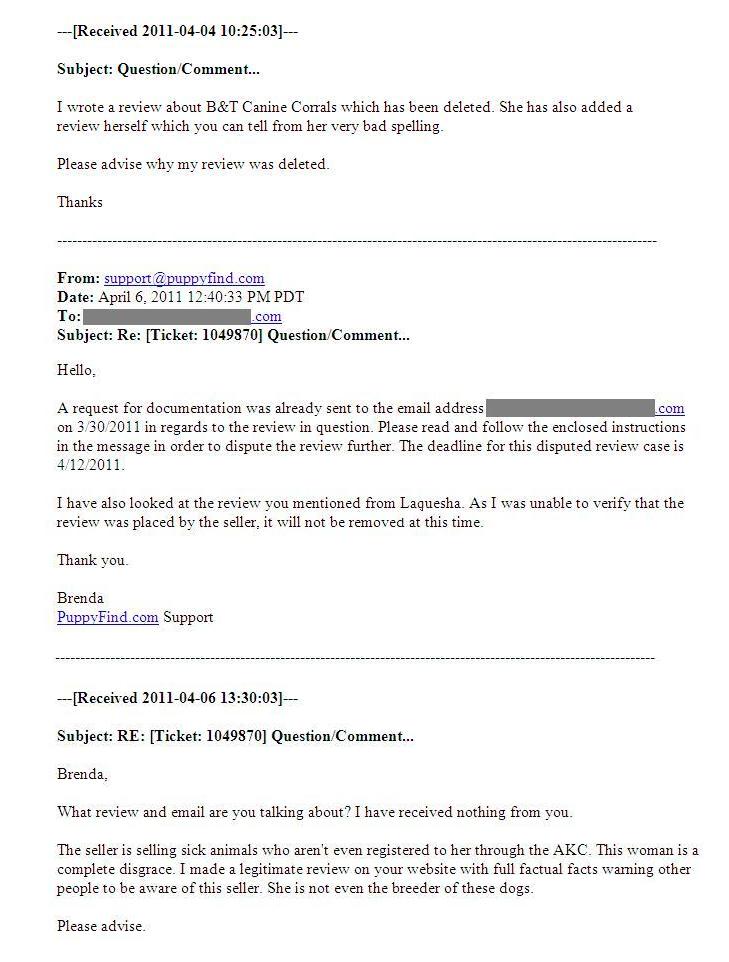
Eventually puppyfind.com forwarded the Email regarding the review. Here it is in all its glory…
From: support@puppyfind.com
Subject: Re: [Ticket: 1049870] Question/Comment…
Date: Wed, 6 Apr 2011 15:07:43 -0700
Hello,
Below is a copy of the documentation request email that was sent to you on 3/30/2011. Please note that documentation must be received by 4/12/2011.
***
This is to inform you that Puppyfind.com has received a request to remove the review you submitted on: 3/15/2011 for seller: B and T Canine Corrals as an invalid review. The review in question is currently hidden from public view while we proceed with the disputed review process.
If you wish this review to once again be visible to the public, please respond with the details of your complaint along with any supporting documentation you may have. This documentation could include Vet reports, copies of email communication between you and the Seller, contracts, guarantees, etc. If your review is in regards to a medical issue, a written statement from your vet is suggested.
You can fax this information to 1-480-629-8020 Attention: Quality Management, Case #272594-4736309. Please be sure to also include your name and the email address you used on our site.
We also request that you include a phone number where we can reach you if questions arise regarding the documentation provided.
Please note: Your information will need to be provided to the breeder in question to allow them the ability to formulate a proper response and/or contact you to resolve this dispute. If this is a problem and you do not wish to let the seller know who you are, I will be unable to continue with the review process.
If no response is received from you within 2 weeks from the date of this notice, we will assume that the review you submitted is no longer valid and will allow it to remain deactivated.
Reviews are handled Monday through Friday 8am-4pm MST, excluding holidays.
If you have any questions, please feel free to contact me.
Brenda
PuppyFind.com Support
Oh Brenda. I have so many problems with this Email, on so many levels, I don’t even know where to start. But in the end, and I think you’d agree, it comes down to principle. Just because a review is negative does not make it “invalid”. And just because the seller on your site doesn’t like it, does not give them the right to get it taken off (even if they are paying you a service fee).
When was the last time you had to prove that the dirty diner down the road, with the rude waitress and awful food was the worst restaurant you ever went to? Or that Gigli deserved those 153 Rotten Tomatoes?
Well puppyfind.com, you’ve lost all ounce of credibility where I am concerned. You may be able to blind visitors on your own site, but yours isn’t the only outlet for communication, and the quicker you realize this the better. In the end, the truth will out.
And just for the hell of it, here’s that review my friend posted about B and T Canine Corral; the one that you didn’t want people to see just because it wasn’t all unicorns and glitter. I don’t think my friend should waste any more time going through your antiquated process. It’s 2011. Get with it.
“I’ve had dealings with this breeder [B and T Canine Corral] in the past and would not recommend her to anyone. In my experience, this breeder (though calling her a “breeder” is questionable in itself) is more like a glorified puppy mill. My dog arrived sick, and the breeder showed no regard for the animal’s welfare at all. The AKC registration I received wasn’t even under the “breeder’s” name. It seems that money is her only motivation and she cares little about the animals she is selling. Avoid the heartache I went through, and avoid her at all costs”.
At SMX West this month, I sat on a panel about how large advertisers are budgeting for 2011 and beyond. Here are three of the questions asked during the panel which can help you bag more budget for search marketing.
1. What’s your approach to budgeting and planning?
Prioritize According to Business Objectives — Figure out what countries, markets and product categories are most important and portion out the budget accordingly in your plans.
Play to the Strengths of PPC and SEO — Ask yourself whether your PPC and SEO objectives the same, or different. I’ve found that SEO delivers much higher quality visitors compared to PPC. Yet, as we all know, SEO takes a lot of time and resource and drives more long-term results. On the other hand, PPC has that advantage of instant reach, particularly when entering new markets where you may be less well-known and you are trying to better establish yourself.
Plan Ahead — When you do put your plans together, always think one step ahead and highlight funded vs. unfunded activities (with investment and projected metrics included) so that management know up front about opportunities that require additional investment for increased performance. There will be opportunities throughout the year where additional budget becomes available, so make sure you’re in line first.
2. How do you communicate performance to management and executives?
Communicate Often — Where management is concerned, it is always important to plan ahead, set clear metrics up front, and communicate regularly in order to keep search front of mind. They have a lot of things going on all the time, so it’s important not to operate within a bubble.
Speak Business Metrics — When you report out, keep it simple. There will always be a lot of detail behind the data, but it’s important to focus just on those high-level metrics that matter most to them. Depending upon your organization, soft metrics like awareness and engagement don’t always speak well to management and executives. What executives understand are business metrics, like revenue and return on investment, so this is often the best way to communicate performance to them.
Show Missed Opportunity — Gap Analysis is a great way to not only show performance from investment, but also to try and secure additional funding by looking at gaps in spending and gaps in performance as a result. In essence, it’s an easy, visual way to let management know what they are missing out on as a result of not spending a certain “ideal” amount.
3. Many companies devise quantifiable ways to set budgets. What solutions and process would you recommend?
You can’t justify what you can’t measure, so the key to justifying budgets is making sure you have strong web analytics in place.
To justify your budgets you want to get your post-click data linked as closely as possible to revenue because no one wants to put budget into something that has negative return. If you have an e-commerce operation in place then this is quite straight forward as your main measure will be online sales from search (from which you can easily calculate ROI). But sometimes, particularly in B2B environments with longer buy-cycles and big price-tags, your campaigns may be focused earlier on in the sales funnel; you need to fill the funnel and identify certain quality indicators of your visitors.
One way to do this is to identify a set of key events that demonstrate good quality engagement; events that are most likely to lead to a conversion or a sales lead. This could be anything from downloading a premium piece of literature, to locating a sales office, to requesting a quote or a demo. From this you can then start to track conversions and calculate business metrics such as cost per conversion.
 SEM Booty Blog