
Conference season is in full swing, and over the past month I’ve been speaking on some different panels around the topic of paid search and paid social. Paid search being traditional PPC advertising in search engines, and paid social being paid advertising in social media channels — for example, promoted YouTube videos, Facebook advertising, and promoted tweets.
Here are three of the questions that were asked during the different panel sessions, and some of my thoughts around the topics:
How do you think about paid social compared to paid search when it comes to campaign strategy?
As with any strategy, it’s important is to be clear from the start as to what it is you are trying to achieve. Paid search and paid social are complementary, but whilst paid search can successfully span all stages of the marketing funnel, when it comes to paid social, I’ve often seen better success for campaigns specifically focused in the learning phase.
With traditional paid search you can land certain searchers who show buying-intent through their keyword query, directly on a sales-related or e-commerce pages and look to convert these people quite successfully. That’s a lot more difficult to do well with paid social, simply due to the nature of social media. With paid social you often find that it takes several more steps, across several different channels before people are ready to buy, so that’s something that needs to be taken into account when putting together your campaign and overall program strategy.
What have you found to be the major differences or strengths of each marketing discipline?
In addition to the funnel differences, there are also differences when it comes to intent and level of targeting.
When someone is using a search engine, you know they are on a mission to find something — so target your ad right for that person who is actively looking for an answer, and you will see very healthy results.
On the other hand, social media tends to be more opportunistic and interruption-based in nature. Although paid social may not always address the same level of intent exhibited through search, it wins hands down when it comes to targeting, as it can go beyond just keywords. Depending on the vehicle, you can target by:
- Education and workplace
- Demographic data
- Interests
- Behavioral targeting
The real power comes when you combine all of these factors together; that is where you can start to get really creative. If your company has developed clear customer personas, then paid social can make a great targeting tool.
What do you think about the future of social media results appearing on the search engine results page?
We’ve been talking about the relationship between search marketing and social media for a while, but only now are things starting to get really interesting.
It is difficult to think about social results appearing in search engines, without thinking about Google Plus. With the release of Google’s Search Plus Your World, we are starting to see a much stronger convergence between search marketing and social media because an individual’s results are greatly influenced by their social circles. I think this will have a number of implications moving forward.
Despite level of popularity right now, I do think it is important to get your business on Google Plus and make sure it is connected to your website, particularly with the emphasis Google is putting on G+ as a social search signal.
Content has always been important where SEO is concerned, but as social signals start to play a more important role, we need to make sure that the content we develop is not only relevant but also worthy of being shared and liked.
With this in mind, social SEO and social influence is becoming the new linkbuilding. With Search Plus Your World, the online experiences of your social connections are more relevant to your personal search results than factors like links and domain authority.
And of course, all of this makes measurement a lot more challenging. What appears as the number one organic rank for one person, may not rank at all for someone else, depending upon their social circles. Add to that all the issues around data privacy and personalized results and you potentially end up with a lack of data and insights for your programs.

SearchFest 2012 took place in Portland last week, once again bringing together everything search and social in the Pacific Northwest. Here are my three key takeaways from this year’s event.
1. Search and social marketing is very much alive and kicking
The morning keynote from Eli Goodman (ComScore) threw out some pretty compelling statistics where search marketing and social media is concerned, including:
- There are more than 3.5 million search engine searches being made per minute
- 42% of people are logged into Google when they search
- Google +1 results are showing up for over 1.2 million searches
- 12% of Google searches contain social signals (compared to only 5% in Bing)
Google Plus may not be popular amongst the search community, but it’s a force that can’t be ignored. With Google+ we are now seeing a much stronger convergence between search marketing and social media. With the emphasis that Google has been putting on Google+ as a social search signal, SEO folks should be caring very much right now about social signals and social influence, and what this means to organic rank.
2. Company education is a must
The problem with social media is that “everyone” is an expert… or so they think. In the Social Analytics session, Kelly Feller (Citrix) and Justin Kistner (Webtrends) highlighted to me the importance of social media education within a client company. In particular:
Moving people away from a check-list mentality — People within your company need to understand that setting up accounts in places like Facebook and Twitter is very much a long-term commitment, not a short-term campaign, nor something that simply gets checked off your marketing “to-do” list.
Setting up a Facebook page simply to support a one-off launch or program that goes away at the end of the month is about as stupid as buying likes or followers (ie: please stop this madness). Which leads nicely into…
Helping marketers to understand the concept of EdgeRank — Followers are important, otherwise you’d be wasting time talking to yourself. However, follower count should never be your main success metric. Justin revealed that on Facebook, less than 3% of your followers will actually see your page content. This is because of EdgeRank.
In short, EdgeRank is Facebook’s algorithm and it decides whether or not your post is worth showing on people’s news feed, based upon whether your followers are interacting with it (for example, through liking or commenting). Essentially, what this means is that having 100 followers who interact with your Facebook content is better than 100,000 followers who don’t.
Surprisingly, not a lot of general marketers know this. It’s often assumed that if something gets posted on your page, then it will go out to everyone. Not true. Unfortunately, this can lead to some silliness when it comes to setting metrics and the use of campaign-based accounts.
At one point, Intel had over 200 different Facebook pages, most of which were lying dormant after campaigns came to an end. I can’t help thinking that a better understanding of these concepts up front could help reduce some of the clean-up further down the road.
3. Use site maps for universal advantage
We know that HTML and XML sitemaps are important to help search engines index and “understand” the structure of your website content. Often, our sitemaps are based on products/services. However, Marshall Simmonds (Define Media Group) and Rhea Drysdale (Outspoken Media) highlighted the importance of sitemaps that help support our presence in universal search results, including sitemaps for:
- Video
- Images
- News
- Blogs
Where video is concerned, you can also add your YouTube videos to your video sitemap, as long as the video is embedded on your site. Why would you do this? Because over 80% of universal video search comes from YouTube.
Additional Information
Catch up with all the action from this year’s SearchFest with the event hashtag #searchfest

It was Covario’s client conference, INFLECTIONPoint, last week. Here are the key lessons I took away from the various panel discussions, case studies, and keynotes.
1. Surround yourself with people smarter than you
When Billy “Moneyball” Beane kicked off the first day, there were some great real-life applications of how data and analytics can help you make more informed business decisions. Billy had the vision, but he didn’t have the advanced analytical prowess to turn that vision into a reality. That’s why he hired numbers geek, Paul DePodesta. During that one hour keynote, it was Paul (not Billy) who became my hero. All I can say is, English football can learn a lot from the sabermetrics approach (new England manager, please take note!).
So rather than trying to be an expert at everything (which will lead to inevitable mediocrity), surround yourself with the best in order to raise your business game to the highest level.
2. Social media metrics should be short and long term
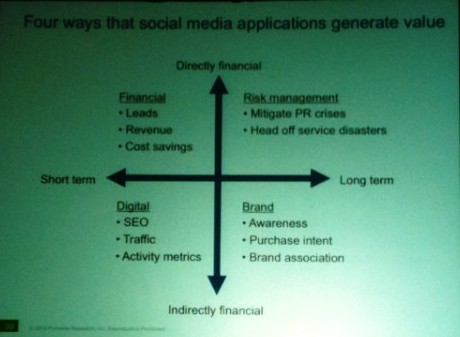
The Social Media Value Quadrant
Josh Bernoff’s day two keynote neatly summarized all those familiar examples of companies who have either suffered the wrath of angry socially-connected customers, or utilized them in clever ways to the company’s benefit.
However, the one slide that stuck with me, was a quadrant diagram showing four ways that social media can generate value:
- Directly Financial vs. Indirectly Financial
- Short Term Value vs. Long Term Value
My feeling is that many companies, in an effort to show some kind of return on social media, focus too much on short-term impacts (traffic, leads, revenue, savings). Whilst this is understandable, especially given the current economic climate, we should not lose sight of the long-term impacts (risk management, branding implications) that social media can have too. We do, however, need to find better ways of measuring/showing these impacts in a way that doesn’t come off as fluffy. And that, I think, is where the big challenge lies.
3. Increase your chances of being viral by looking at data trends
Jeff MacGurn’s case study on SOPA and viral campaigns threw out a bunch of interesting insights. Covario analyzed over 50,000 pieces of content and found that:
- Thursday is a big day for content to go viral
- The majority of popular content tends to go viral late afternoon as people start to wind down for the day
- However, “serious” subjects tend to go viral in the morning when people first get into work
- Of the popular content that goes viral, 20-30 people tend to be responsible for it
When looking at recurring traits, Covario found a pattern as to what made viral infectious. These included the use of hook lines, the mention of a well-known brand, popular keyword usage, a sprinkling of humor, as well as a little contention.
So to summarize: know the optimal days/times your audience is using social media, know who your influencers are, know which social media vehicles they are using, and always use appropriate targeting.
4. Every company has their own search challenges
Big or small, under- or over-funded, all companies have their own challenges when it comes to search and social media marketing.
Whilst small teams run into resource and budget issues, they are a lot more nimble (a HUGE benefit when it comes to SEO and social media) and they can integrate campaigns with relative ease. Big companies may have the money and the manpower, but their organizations tend to be heavily siloed, leading to a lack of integration between PPC, SEO and social media, and a whole lot of frustration when it comes to process overload and cross-department buy-in, particularly when each department has different goals.
I guess my point is, if you are one of the small guys, the grass isn’t always greener. More people and budget may solve some problems, but it also creates a whole bunch of others.
5. The elusive “year of mobile” is… here?
Whether the “year of mobile” is truly here or not, it is clear that mobile is something that can’t be ignored:
- 6.8 million smart phones were activated on Christmas day
- 350 million users actively access Facebook through their mobile devices
- Search engine websites are the most visited sites on mobile
There’s no getting away from it. Our sites need to be mobile friendly and mobile optimized.
Additional Information
Also check out Search Engine Watch’s review of InflectionPoint. Miranda’s coverage of the conference was excellent.

We may only be three weeks in to 2012, but already things are chopping and changing in the wonderful world of search. Here are a few resolutions to help make us better search marketers.
1. Never Stop Learning
Someone once told me that they knew everything there was to know about SEO. They lied.
Sure, there are experts out there but in a world that never stops changing, it’s impossible to know absolutely everything, particularly when it comes to search. This is why it’s so important to keep up to date, learn from the best, and share the knowledge so we can keep getting better. If there’s one thing I’ve learned these past few years, is that the search community never stops giving when it comes to great search and social media related content, tips, tricks and hard lessons learned, so there’s really no excuse not to learn.
There are so many changing topics we need to keep on top of, and 2012 will be no exception. We’ve been discussing search, social and personalized search for what seems like forever, but only now are things starting to get really interesting.
2. Use Data Over Opinion
Sales people think they are experts in marketing. Marketing people think they are experts in sales. Everyone is a guru in social media. Oh, and your website should be blue instead of red.
When it comes to marketing, search marketing, and social media marketing, there are a bunch of opinions out there. But the only opinion that really matters is that of the customer. A lot of direct customer input can be acted on through data that many of us can see every day, including:
- What are customers searching on
- What keywords convert the best
- What feedback you receive directly from customer surveys, tests, or social media
- What online comments, feedback, ratings and reviews customers are providing
2012 for me is not just about data collection, but how to analyze data to better educate, inform and improve business. Using data to answer tough questions, such as:
- Where to prioritize time, based upon the social media channels that your customers are active in
- Whether the content you produce is actually helpful for your customers or not
- Whether products are meeting customer expectations
- What other aspects of business you can improve on
- The list goes on…
3. Talk Less, Listen More
Ok, this is probably more of a resolution that I would like other people to adopt, but know I could do with a bit of this myself also.
Not only is it important to listen to what your customers are saying and listen to what data is telling you, it’s also important to take the time to listen to your peers and colleagues.
Some of the time, we can use data and experience to tell people whether they are speaking total crap. Other times we might just find we learn something new and completely eye-opening. I’ve stumbled on a good few golden nuggets recently, simply by listening. Definitely one to keep up this year.
What resolutions do you have?

The first words I uttered when 2011 arrived was, “Enjoy 2011, because the world is going to end in 2012”.
Of course I don’t really believe that, but it seems like only yesterday I was joking about it. Yet, what do you know – 2012 is less than two weeks away.
If search engines had zodiac years, 2011 would be the year of the panda… with a bit of honey badger thrown in for good measure. As usual, we saw countless updates to keep us all on our toes – from the string of Google panda and freshness updates, to other distractions such as authorship mark-up and schema.org, not to mention the arrival of the supposed “Facebook killer“.
So with all this going on, what key lessons did I learn this year?
1. Focus your Priorities
I’m not sure if you noticed, but Google et al. have no problem keeping us on our toes. And even though search marketers hate standing still, most days seem like having to go from running a ten-minute mile to a five-minute mile… and that’s not even taking into account your own company dynamics. Suddenly your smooth running track turns into an obstacle course, with several mud pools thrown in front of you along the way.
At any one time, there can be so many different areas to focus on and unless you have been blessed with unlimited resources, you simply can’t do everything (or at least, you can’t do everything well).
So what do you do?
- Figure out what’s important to your program and what’s going to give you the best benefit (unfortunately, this isn’t always what’s the most fun)
- Prioritize and do those things really, really well
- Action those areas that you can (or more easily) control, and plan out how to influence those areas that “tradition” says you can’t
2. Remember, “All for One, and One for All”
With all the updates this past year, one thing is crystal clear: you can’t succeed without a tightly integrated approach to SEO, PPC and Social Media.
SEO and PPC
SEO and PPC work together. There’s plenty of cannibalization discussions out there, but overall you do get an incremental lift when using both together (a 2011 study found that PPC gives a 89% incremental lift in total site visitors – above and beyond traffic you would normally expect just from SEO).
One of my key learnings this year included how to report on success. If you are reporting out on Search KPIs to upper management, I’m an advocate of having SEO and PPC numbers combined. If you have solid PPC and SEO programs in place, there’s just too much interplay between the two to look at them in isolation, at least at that high level.
Now at an operational level, of course you should monitor the numbers separately. But this is needed more in order to manage and understand individual contribution and performance on a day-to-day level, so that tactical adjustments can be made, as needed. This is where the detail comes into play since there can be many moving parts. However, most times this detail can be difficult to quickly understand unless you are living and breathing search 24/7.
Social Media, SEO and PPC
We also saw social media becoming an influence where SEO is concerned. As Google continues in its quest for G+ domination, we need to keep a close eye on the growing importance of social signals.
On the PPC side, paid social (be it on YouTube, Facebook, Twitter, etc.) has also been taking steps forward with improvements in targeting, reporting, and arguably set-up… depending on the platform! One takeaway (quite basic, but often overlooked) is to ensure that a portion of your overall search budget gets cornered off to support these paid social efforts.
3. Balance your Learning and Doing
Unfortunately it isn’t possible to always “do, do, do…” without also keeping up-to-date on important changes that constantly go on in this industry. Similarly, there’s no point in learning and knowing the “theory”, if you aren’t going to apply this knowledge and test it out for your particular company or program.
Yes, best practices can often apply on a general level, but if you really want your program to excel, you need to figure out the best practices that apply to your specific situation, and the only way to do this is through testing.
So make sure you learn. Make sure you apply. Make sure you to test. And then repeat over.

Google’s freshness algorithm update was announced at the beginning of the month. The update rewards fresh content by prioritizing more recent results in the Search Engine Results Page (SERP), particularly in areas covering:
- Hot news topics (EG: the debt crisis, political movements, celebrity gossip etc.)
- Recurring events (EG: sporting events, conferences, holidays etc.)
- Frequent updates (EG: product updates, pricing updates, reviews etc.)
According to Google:
“Different searches have different freshness needs. This algorithmic improvement is designed to better understand how to differentiate between these kinds of searches and the level of freshness you need, and make sure you get the most up to the minute answers”.
So with “freshness” continuing to be the name of the game for Google, what should SEOs be paying particular attention to?
1. Content Marketing
It’s not enough just to have great content anymore. You need to have great up-to-date content, and a steady flow of it, all the time.
This calls for a solid content strategy, which should include figuring out those important content topics, how you will support these topics over time, and in which channels — be it through blog posts, white papers, videos, press releases… or a combination of all.
2. Press Releases
For certain searches, news results now appear at the very top of the SERP. Make sure you work closely with your PR manager to ensure that press releases are keyword optimized prior to being wired out — particularly for searches that are being impacted by the news results.
Don’t just focus on news relating to product releases and updates, but also look for other opportunities to tie your company and/or products to newsworthy events, as well as regular shows/exhibitions/conferences that you have a presence at.
3. Ratings and Reviews
Ratings and reviews play an important role in helping to capture those long-tail searches and it also helps to keep your page content fresh through new product review information. This plays perfectly into the freshness update, providing even more reason to have ratings and reviews on your site, if you don’t already.
4. Blogs
Blog posts on your website are a great way to share content on a regular and ongoing basis, and can compliment news-related topics well by showing a particular point of view.
It may be helpful to build out a schedule of topics (and writers) to help with a steady stream of content, since anyone can suffer from blogger’s block from time to time! Just like your press releases, make sure your blog posts are optimized for important keywords and encourage readers to comment.
More Useful Information

After all the waiting, Google finally introduced Google+ Pages for business last week, and since then there’s been a big rush by companies to claim their page.
When Google+ first launched, I explored some implications for search marketers. But with last week’s announcement, how might Google+ Business Pages also impact search?
1. Google+ Brand Pages in Search Engines
One thing I love about branded searches is guaranteed, quality traffic to your site. Now Google wants some of that action too.
Google will be including Google+ Pages in search results, but it doesn’t end there. They are also introducing a new feature called Direct Connect which allows searchers to directly connect with your Google+ Business Page, simply by searching for “+[company name]” (ie: it takes searchers to your Google+ brand page instead of directly to your website).

Macy’s Google+ Brand Page in Search
So make sure you grab hold of your company name page, particularly since no real verification is needed to claim a brand in Google+ (unless you are a mega brand, that is). It seems that right now, anyone can set up a business page for a brand (whether they are related to your business or not), so make it clear that your page is the official one. Also pay attention to your “About” section – include your website address and make use of the “Recommended Links” section on the right nav.
2. Business Popularity by the Number
All search marketers know that links have an important impact on rank — it’s a good indicator of content relevance and popularity and it helps to differentiate your website pages from other competing websites. Unlike page elements (such as title tags, heading tags, alt tags etc.), good quality links are not as easy to control, manipulate or copy.
Social indicators of business popularity and relevance (such as likes, tweets, and now +1’s) have always been the logical next step. But unlike Facebook likes and Tweet counts, Google owns the firehose of +1 data. We’d be naive to think that this won’t have the potential to impact business rankings within future SERPs.
3. +1 Your Site
According to Google, business pages will have an overall +1 count which will reflect not only the people who have +1’d your business page, but also all the people who have +1′d content on all the pages in your entire website.
So if +1 does become a part of Google’s ranking algorithm (and I probably wouldn’t wait to find out), then it’s time to get a move on with adding those official +1 buttons to your website and your page content, especially since the buttons help to send site traffic your way anyway. A recent Hubspot report found that websites that used the Google +1 button generated 3.5 times more traffic from Google+ than websites that didn’t have the button.
Additionally, with Google displaying +1 counts next to page results in the SERP, how are they influencing click behavior? For example, if the Number 1 result had no +1 information associated with it and the Number 5 result had hundreds of +1’s, are searchers going to follow the masses and click on the lower result which appeared more popular?
Some early research indicates that results with +1 information does lead to higher click-through rates compared to results without. With this in mind, it seems a top result without +1 information would find it hard to maintain position. Whereas lower results with high social approval have good potential to move up the SERP.
4. Circles and Page Posts
With circles, there are definite opportunities to target certain posts to specific groups of customers or stakeholders through your business page.
However, before you can add people to circles, they need to add your Google+ Page first. This means that getting the word out about your page and adding regular, interesting content and discussion, will help to encourage following — similar to other social media platforms like Twitter and Facebook.
This typically takes time to build up though, so the immediate opportunity is to make your Google+ Page posts public so that Google knows to index your content publicly to appear in search results. As you share content on your page, remember to keep social signals in mind by pairing appropriate keywords with links in your posts, as well as building up those +1’s and shares to show content popularity.
5. Product Category Pages
With Google+ Pages, you can set up more than one page for a business. One area which is particularly interesting is Product pages.
With Product pages, questions start to arise, including:
- Will Google start to draw links between business popularity and respective product category popularity to determine rank?
- Will the most popular product pages eventually start showing in the SERP above standard HTML pages?
- Will product pages have their own dedicated vertical in the SERP or be blended into results, similar to video?
- Will product pages eventually be incorporated into the the Direct Connect feature?
…So many questions! What thoughts do you have?
More Useful Resources

In addition to your typical, ongoing paid search campaigns, you will likely have campaigns that are adhoc in nature — maybe to support a short-term sales program or an event such as a seminar, webinar, conference, or tradeshow.
As the benefits of PPC start to become better known within the wider organization, I’ve seen more adhoc campaigns surface in support of seminars and other events that physically take place in various cities or countries, some with better performance than others.
Here’s some lessons I’ve been learning along the way when it comes to launching a seminar (or any event-related) campaign in paid search, to help increase your chance of success.
1. Allow Time for Testing and Tweaking
I’ve found that one of the most important elements of a successful seminar campaign is planning ahead and giving it enough time to run. Unlike your ongoing paid search campaigns (which you’ve tested and tweaked for years and continue to do so), you have a finite time to get seminar campaigns right; once the seminar is over, the PPC campaign is over too.
One month or less is typically way too short. Two months is ok. On average, three months is a good amount of time to test and tweak a reasonable-sized seminar. However, if your event is a big annual event, then even a year seems reasonable.
2. Pay Attention to Geotargeting
It’s a well-known best practice to target your PPC campaigns to within the location that the seminar will be held. However, don’t just pick a set mile radius and stick with it — distance is an important component to test.
If your geotargeting is too narrow, then you could miss out on many opportunities to get registrants who are willing to travel to your seminar. I’ve seen a 100 mile radius work better than 50; sometimes the opposite. Finding the right distance will be dependent on a number of variables relating to your specific seminar (including appeal of content, quality of speakers, even your lunchtime menu!). So remember to always test and tweak your geotargeting to get the most out of each campaign you run.
3. Target your Adcopy
Set up different adgroups for different seminar locations, and for each group make sure you appropriately tailor the copy to each location. Include mention of the location, city, date, and if the seminar is free, call it out.
If you are running any free offers or appealing giveaways, then make sure you mention this too. It’s amazing the behavior you can encourage with mention of a free iPad drawing!
4. Test the Content Network
When you geotarget, you improve your targeting (and conversion rate percentages), but at the same time you’re working with much smaller numbers. Expanding out into the content network is a good way to try and increase reach, often at a lower cost per click.
Although you’ll see click/registration/conversion rates go down due to the increase in impressions, at the same time you’ll see an increase in actual click volumes and likely registration numbers. It’s a fine balance to get ROI right, which is why it’s always a good idea to test.
5. Capture Post Click Data from Registration
As with all your paid search campaigns, remember to make sure your analytics are set up on the registration page so you can track registrations back to PPC.
When registration happens on your own website, this should be pretty straight forward to control. However, if registration happens on a site outside of yours (perhaps a publication or partner site), you need to make sure they have the appropriate tracking in place in order to show the ROI on your campaign. If you aren’t able to track this, then take a hard stand and don’t start your PPC campaign until you can.

If, like me, you’re getting ready to write your annual search marketing plan, you’ll be starting to think about what initiatives you need to prioritize time, budget and resources for in the coming year.
Here’s a few thoughts and questions that will be top of mind for me in 2012. The following doesn’t provide answers (as the answer will depend on your company and the maturity of your search program), rather it is intended to get the thought juices flowing!
1. Content
Once you have applied all basic optimization to your pages, link building — and content that is linkable — starts to become a pretty big deal. Do you have content on your site that people want to link to? Now take a hard look at the page you are trying to get links for and ask yourself, “Is this really something that people would want to link to?”.
Do you have resources in-house that can build new content or develop existing content? Or do you need to set aside budget for someone to help you in your mission for good, linkable content development?
2. Link Building
Once you have that content, how are you going to get people to link to it? Is specialist support needed to help you develop a cohesive link-bait program or do you have the skills in-house to handle this? Does it make sense for you to “prime the pump” so that you guarantee links prior to even investing time or money on developing content? If so, how will you do this?
What approach are you taking to build out your link graph? Have you really thought this through to the point that you have an actionable strategy in place, and is this strategy scalable? Link building, when approached right, can be more than a full-time job in itself, so if you don’t have resources to handle this in-house, you’ll need to set budget aside for agency help.
3. SEO and Social Media
Studies carried out earlier this year showed a correlation between SEO and social media. With this in mind, are your pages and content already set up to take advantage of social factors that are used to indicate content popularity and relevance?
If not, how will you get a handle on this? Is it a case of just including share and like buttons on your content, or does it play a more integrated role in your link building programs?
4. Paid Ads and Social Media
Paid ads in social channels (such as Facebook, YouTube) can be an effective way to reach customers, when done right.
If you have not yet step foot into paid social media ads, is this something that you should be testing out? If so, do you have budget set aside to support this effort?
If you’ve seen success in social channels, is it time to split out your PPC media budget into traditional search and social search buckets? And of course, if you’re starting to scale up on these efforts, is paid social something you can handle in-house, or something that you’ll need outside help managing?
5. Beyond your Traditional Search Approach
If you’ve slayed the traditional HTML page results in the search engine results page (SERP), where else will you focus on your quest for domination?
Will you go after blended SERP results like video, images and shopping? Or maybe you need to give more love to the local country search engines like Baidu, Naver, or Yandex?
Perhaps you will focus on your results in social channels like YouTube or Facebook, or identifying some priority verticals in your market?
Maybe you decide that with all the updates going on lately that you will simply concentrate your time and effort on maintaining your good position in the main search engines because this is where you gain the most benefit, particularly with the resources you have available. Afterall, SEO is more like a marathon rather than a sprint, so you need to continue to hold onto your lead, particularly for your most competitive keywords.
These are just some of the thoughts and questions that I’ve been thinking about this past week. What other things are important to you as you start planning for next year?

I’m constantly amazed how resistant many companies still are about having ratings and reviews on their website. Rather than declare, “Because it’s 2011!” and list out the many logical reasons why companies should have reviews on their site, I thought I’d take a different spin on things. Here are three reasons why companies wouldn’t want to put ratings and reviews on their website.
1. Your product sucks
You don’t want to put ratings and reviews anywhere near your website because (shhh…) your product is a piece of crap. It’s difficult to use, parts fall off it, it’s overpriced, and you avoid talking to your customers because all they do is complain. It’s their fault for buying such a heap of junk to begin with. Losers.
Let’s face it, if your product truly sucked, you wouldn’t be in business for long regardless of whether you had ratings and reviews on your site; it really wouldn’t make much of a difference. If however, you are proud of your company, have a good offering and are confident in the merits of your product, then what are you worried about?
2. You hate change
You’ve lived without ratings and reviews for decades and everything’s been hunky dory. Why on earth would you want to break away from the mold. Change is for the reckless — just look what happened with all those dot.coms in 2000. That direct mailer you’ve been sending out for years comfortably gets a 0.21% fax back response. It’s doing just fine, thanks.
Like it or not, change is constant; adapt or die. Yes, it can be scary, but the best way to learn, improve and do better business is to listen to what your customers (you know, the people who give you money) have to say. Take the good with the bad and act on it.
3. You don’t want people to say bad things about you
There are over 346 million web sites on the Interwebz, but you’ve convinced yourself that your website is the ONLY site that customers trust when researching your products. Customers only believe what they are told, so you only tell them what you want them to know; all the good stuff of course. You control the conversation because you’re the only one that’s talking. If you ignore the bad stuff then it doesn’t exist, and people are none the wiser… at least up until the point that you’ve pocketed their cash. Ker-chiiing!
Even if your product is really good, no-one — not even Apple (think Antennagate) — has a perfect product. If people have something bad to say, they will say it — be it on your site or somewhere else. Like it or not, the power has shifted and people now have more resources available to them to get the word out, and quickly. This is your chance to take control of the situation and address it in a positive way, for all to see.
So what are you waiting for?
If you are still wondering whether ratings and reviews is the way to go, listen to the voice of reason. If your product doesn’t suck; you want to grow and improve; and you are willing to put yourself out there to better support buyers, then you will ultimately be on the path to selling more. As a bonus, you can throw in the UGC benefit of all those long-tail searches too.
 SEM Booty Blog