Search Engine Optimization is such a rich subject. I am by no means an SEO expert, though I strive towards this close-to-impossible goal!
Over the past few weeks, I’ve been trawling through a lot of good (and not so good) articles on organic search. To help save you time, I’d like to share three choice picks with you.
SEO Hierarchy of Needs
Maslow’s classical hierarchy of needs has been pulled into the 21st Century and applied to SEO. The framework lays out the building blocks a website needs in order to secure a good search engine rank – a journey which begins with Keywords and Content (the most basic need) all the way through to Link Development (the point of self- or rather website-actualization).
What is key throughout this journey is ensuring effective Analytics and Web Intelligence in order to understand your site and measure your level of success.
Read the Full Article: SEO Hierarchy of Needs
SEO Guide for Web Designers
Damn these web designers with their Flash Splash Pages and Click Here anchor text! I was absolutely mortified to read that:
- 1 in 10 web designers don’t think SEO is mandatory
- 24% of web designers don’t even know what SEO is
This article provides basic, but essential, “don’ts” for web designers. I guarantee that you will come across something on the “don’t” list that is happening on your site right now. Make sure you print this one out and glue a copy to every monitor belonging to a web developer.
Read the full article: SEO Guide for Web Designers
17 Ways Search Engines Judge the Value of a Link
This one comes courtesy of those smart people at SEOmoz, who do a great job explaining the most important factors that search engines consider when judging the value of a link. It certainly helped to answer a lot of questions I had when it comes to link value.
Most interesting take-aways included:
- The concept of TrustRank (you want to be linked as close to a trusted site as possible)
- Getting inbound links from diverse sources is more powerful than lots of links from the same source
- Link value differs with page location. For example, a link included within your page content is more valuable than a link within the top navigation, which is more valuable than a link in the side bar, or in the footer
- Earning links from a particular region will help you perform better in searches made within that region
Read the Full Article: 17 Ways Search Engines Judge the Value of a Link
If you have come across any interesting articles on SEO, please feel free to share.
Product support-related searches on Google will often include Forum results – people discussing you, your company, your products, your customer care. A search on “ipod forum” brings up 139 million results. Whilst “pc help” brings up 240 million. These may be extreme examples, but wouldn’t it be nice for your own company-hosted forum to appear in the top rank when someone typed in a support-related query for your company or products?
Google may be Number 1 when it comes to search engines, but YouTube is the second largest search engine in the world. Additionally, immediate events (real-time search results) aren’t easily searchable outside of Twitter.
- Better real-time search results
- Personalized search results based upon social data
- Searcher intent becoming clearer with geographic location, time and social context
- Search recommendations based upon reviews from people we know, rather than from complete strangers
Just think – you’re stuck in your hotel room in a strange city, and your stomach is growling. You need to find a place to eat. The search engine detects your geographical location, and recommends a restaurant two blocks away, based upon positive reviews from friends within your social network. Heaven!
These are just some of the reasons why search should care about social. I am sure there are more (feel free to share ideas). It also serves as a good reminder that moving forward, people need to be at the center of our search strategy, not keywords.

When you have thousands of adgroups and keywords to cover and not enough money to cover them, what do you do?
To try and answer this question, I conducted a test to see where I could get the most bang for my buck. This is what I found:
Approach 1. Spread Thin
Spreading PPC budget thinly across adgroups casts a wide, but shallow net; you cover all bases, but end up “going dark” early on in the day. In addition, the quality of engagement from these visitors is lukewarm.
Approach 2. Go Deep
Focusing budget on the top performing adgroups produces a higher level of conversions, with visitors clustered more towards the buy phase. However, as the net is narrow, there are much fewer visitors being caught. In addition, the keywords belonging to top performing adgroups tend to have a lot of competition, and consequently have a much more expensive cost-per-click (CPC).
Looking at these two approaches, the road you take would probably depend upon the goal you are trying to achieve:
- If you want to drive traffic to your site, then the “Spread Thin” approach makes sense
- If you want to drive conversions to your site, then “Go Deep” delivers
My goal was quality over quantity, so in this case, “Go Deep” was the way to go… Or was it?
Considering the Customer Journey
There are additional, important implications of taking a “Go Deep” approach that needs to be considered. In particular, the matter of assist attribution.
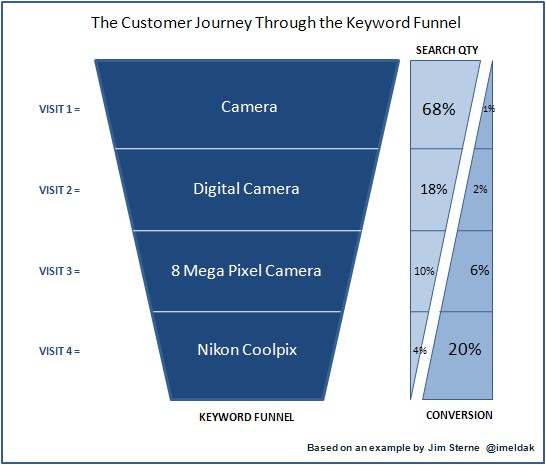
My eyes were first opened to the concept of assist attribution in a talk given by Jim Sterne at SES San Jose. The idea is that although general keywords used at the start of the customer journey have a low conversion rate, they can actually assist higher converting keywords further down the keyword funnel. Therefore, by removing assist keywords, you reduce conversion of your higher performing keywords later on.
Here’s an illustration to demonstrate this point (adapted from an example given by Jim):
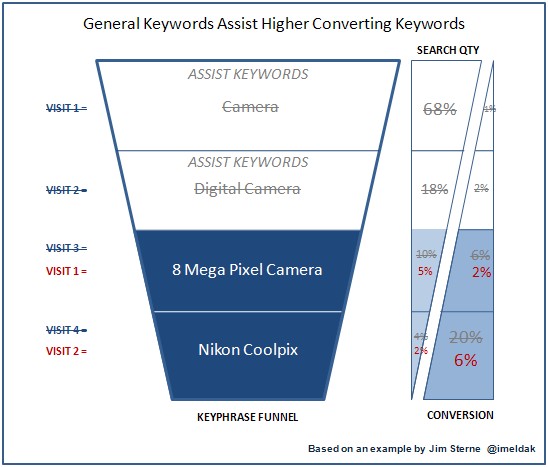
- Early funnel keywords are a necessary part of the keyword mix
- Choosing to go too deep is not a sustainable solution since there is a negative impact on conversions of high performing keywords over time
So what’s the best way of catching a searcher’s attention when you only have the blink of an eye to do it?
Before we move to specifics, let’s take a look from an overall perspective:
1. Write at Least Four Variations of Adcopy
What’s cool about PPC is that the search engine will use all ad variations. It will calculate which ones perform best and then serve the best performing ads most often. This is why it’s good to…
2. Test Copy and Refresh it Regularly
PPC makes it easy to test your ad copy and see what approach works best. This is the only sure fire way of knowing what works. There may also be opportunities to apply your learnings to other campaigns, depending on the elements you choose to test (EG: You may find that the word, “Guide” performs better than the word, “White Paper”).
Also make sure you review your adcopy regularly (aim for 2-6 months, depending on your level of resources and program scope) and refresh your ads, by swapping out the two lowest performing ads with new copy variations. This way you are constantly trying to improve your results.
3. Try to Anticipate Intent
If you keyword is “learn” focused, then make your adcopy “learn” focused also. Talk about resources, tutorials, white papers and so forth. If your keyword is “buy” focused then talk about things like prices, specs, and deals/discounts. My previous post talks more about how to anticipate searcher intent.
Now let’s break down the elements of an ad a little more:
1. Treat Your Heading Like Gold
As with all media, the different visual treatment of headings (and the fact that it appears first) give it more perceived importance by the searcher.
Test out keyword insertion tags as these can often provide an uplift in click-thru rate. A keyword insertion tag is when the search engine inserts the searcher’s keyword into your PPC ad heading (this helps improve the scent from their search to your ad).
If you have a well respected brand name, then remember to make use of it. Include it in the heading (preferable) or in the body copy (at a minimum). For branded keywords, make sure you spell out that yours is the “Official Site” in the heading.
2. Stack the Front
The beginning copy is scanned three times more intensely than the end, so it’s important to get your message (and keywords) across from the start.
3. Break Up Text Patterns
Eyes are drawn to variations in pattern. So where it makes sense, remember to break up text patterns with the use of numbers, particularly if the intent is around buying (EG: use pricing or key specs).
4. Try Using Action Words
Action words can prompt searchers into taking action. For example, words like:
- Get…
- Download…
- Order…
- Find out…
- …now!
And follow these action words by using…
5. Specific Call-to-Actions
Use specific call-to-actions linked to intent. For example:
- Learn: Call out high-value content pieces (guides, white papers, tutorials)
- Buy: Quote, Pricing
- Use: Support, Service
When people search on a broad keyword (EG: computer) it can be difficult to pinpoint what exactly they are looking for:
- Are they looking for a PC or a Mac?
- Are they looking for a desktop or a laptop?
- Are they just browsing or buying?
For broad keywords like this, it is often good to point them to a top-level hub page, with a range of choices and call-to-actions spanning learn, buy and use.
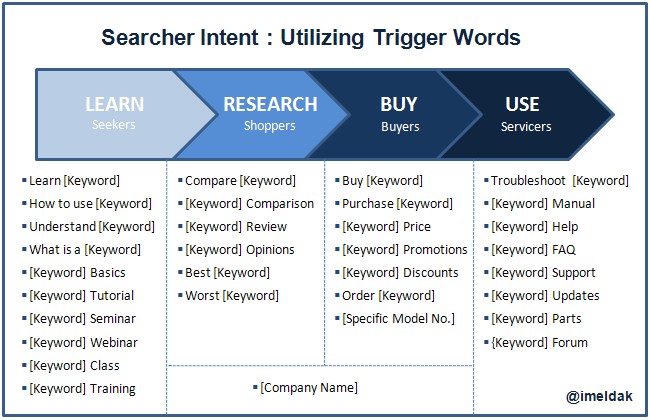
Sometimes though, people use trigger words to narrow their search. Trigger words are words added to a keyword that better qualifies what it is exactly they are looking for. Trigger words are magic as they provide an insight into searcher intent.
When we know the intent of the searcher, we can organize our PPC adgroups in a way that better appeals to their needs, through relevant ad copy and more targeted landing pages.
On the whole, I’ve found that searchers can be grouped into 4 main intent categories, that can be closely mapped to the stages of the traditional buy cycle:
1. Seekers (Learn)
Seekers are in the learn phase of the buy cycle. They seek out basic information and learn about the different solutions that are available to a problem they are facing. With seekers, you better make sure that your site contains good, educational content to cater for this type of searcher. The thing to remember about seekers, is that it’s not all about the hard sell.
2. Shoppers (Research)
Shoppers have a better idea as to what they are looking for. They are looking to compare different solutions, specifications and prices to get the best deal.
3. Buyers (Buy)
Buyers are looking to enter into a transaction. At this point, they have pinpointed exactly what they want, and are looking to get quotes, buy online or find a physical location where they can buy.
4. Servicers (Use)
Servicers are existing customers who have already bought a product and are looking for customer support, replacement parts, and product help. In addition to external search engines, servicers often conduct on-site searches on your website.
And finally, we can map different trigger words to the different stages of intent:
Every once in a while an Email shows up in my inbox that goes something along the lines of:
“Oh my God, we have a HUGE problem!! I searched on [enter some obscure 20 word phrase that no customer in their right mind would ever search on] and we’re not even showing up for it! We need to fix this ASAP!”
Which brings me to the topic of my next post – Keywords. In particular:
- How to identify keywords that customers are searching on
- How to get the best return for the time you spend
The thing that people often forget when it comes to SEO keywords is the “key” part. SEO keywords are an elite set of words that you *must* show up for when a search is performed on an engine. Here are 3 keyword research tips to help you in this very important process.
1. Talk to People
Brainstorm keywords with different people, from different groups, inside and outside of your company. Even better, speak with some customers and ask them. Voice of the customer should always trump everyone else, and can help to validate (or invalidate) internal opinions.
2. Look at Keyword Volume
Once you have finished brainstorming, you need to consider keyword volume. A lot of people often underestimate the time and effort that goes into fully optimizing a page, so you don’t want to waste time optimizing for a keyword that no-one is searching on (see obscure 20 word example above!).
Google Adwords Keyword Tool is a free tool that helps you see approximately how many searches are being made for different keywords. It can also help you to discover a different keyword, or more keyword ideas, that you may not have considered before. When using this tool, I recommend setting the Match Type to “Phrase” match, rather than “Broad”. And don’t forget that you also have the option to select by “Language” and “Country”.
3. Look at Quality Measures
As with anything, it is important to balance out quantity with quality. In my opinion, this is best done by utilizing data from your Paid Search Campaigns, in particular the Quality Score data.
A quality score provides us with an indication of how valuable a visitor to our site is, depending on the keyword that referred them. Typically, the higher quality action they take, the higher their score. For example, someone who purchases from your site – or indicates an intent to purchase (EG: by asking to be contacted for a demo) – is more valuable than someone who just clicks on a link and then leaves.
PPC is a good way to inform SEO in identifying quality keywords. If you’re not sure about a certain “must-have” SEO keyword, then always test it out first on the PPC side to see the level of engagement of searchers coming in on that keyword, before you spend time optimizing a page for it.
In search, there are technical people and there are marketing people. My roots are in marketing, and one thing I know about us “Jack of All Trades” marketing-types, is that we aren’t too good when it comes to technical stuff.
Many marketing people, whose primary role is not search marketing, often see search as black magic. HTML and GIF is about as technical as we get. Laugh as you may, but very often, these are the people who own and write the web content within companies. This is why it’s important for content owners and writers to understand, and apply, the basics of search engine optimization (SEO). This way, everyone is a winner. The key is making optimization a habit so it becomes incorporated into people’s everyday way of working.
Help is at hand. Time to pull out the HABIT checklist – A simple checklist that applies basic on-page optimization to help content owners optimize content, without having to get too bogged down in some of the technical aspects that we, the search marketers, can more easily influence. So without further ado, here’s to making HABIT a habit.
The HABIT Checklist:
H EADLINE
Make sure your keyword is included in your Headline. This is obvious, but you’d be amazed how many times I’ve had to pull people up about this.
A NCHOR TEXT
The Anchor Text is the label given to a link; essentially it’s the link name. Make sure that when there are links pointing to your page content, that it matches the keyword you are optimizing your page for.
B ODY COPY
Make sure that your keyword appears in the first sentence of the Body Copy, as close to the beginning as possible.
I NBOUND LINKS
Make sure that there are links coming into your page from…
- Easy: Important pages within your site (EG: Your homepage and popular hubpages)
- Less easy: Prominent industry sites and sources (EG: .edu and .gov sites)
…and make sure these Inbound Links use the keyword in the Anchor Text. The more links into your page from prominent sources, the more important the search engine perceives your page to be, and so will rank it higher.
T ITLE TAGS
The Title Tag of your page also needs to include the keyword. The format that I’ve found works well is – [Company name] : [Keyword]
And finally, here’s a bonus tip for the marketing people who want an extra power-up:
META DESCRIPTION
The Meta Description is the copy that appears when your listing shows up in organic search. Again, try to include the keyword as close to the beginning as possible, and try not to exceed 155 characters, making sure to include correct punctuation.
HABIT provides a really basic checklist that is easy to follow and apply. It does, however, assume that you know what keyword you are optimizing your page for. So in the next blog post, I will be providing some tips for keyword research.
Now that you are all clued up on the reading front, it’s time to move on from old school methods of learning to something more fun.
One of the issues I’ve found is that things move so fast in the search and social world. This means that most printed materials get dated, and quickly. Even news that appears in an industry magazine ends up being “So two days ago”. In this environment we need a real-time way to keep up to speed.
With this in mind, here are 3 tips to help you stay up-to-date in search and social media marketing:
1. Get Yourself on Twitter
Where better to learn about search and social media than in the place where the Industry cool kids all hang out? A place where news travels faster than earthquakes. I’m talking Twitter of course!
Contrary to popular belief, it isn’t just about what your neighbor had for breakfast or the bowel movements of your colleagues. Twitter – by far – has been the most valuable learning tool for me.
The trick with Twitter is about following the right people. Try to go for quality over quantity (both in terms of followers and followees). Here are few great people to follow. There are many, many more, but this list is based on the people whose tweets I have “favorited” the most, of late:
@mashable
The mashable machine just keeps pumping out real-time search and social news. Myself (and quite a few others, I’ve noticed) are guilty of retweeting a hell of a lot of mashable!
@jowyang
Jeremiah shares a ton of good insights, particularly in terms of what to expect from the future of social media. He also provides examples and case studies of companies successfully using social (lucky people!).
@mattcutts
Matt is the Google Guy – we must play by his rules! He shares links to helpful Google Webmaster videos on YouTube that explain things like “Why are .com sites ranking highly in UK SERPs?”
@socialmedia411
Lots of interesting social media tweets, with little fluff. Just the way it should be!
@simonmainwaring
Simon was a great find on Twitter. He’s full of news and facts that span search, social and beyond. What’s also nice is that he says thank you when you retweet him, and I’m a big fan of nice manners!
@eMarketer and @comScore
These guys provide useful data analysis reports on search and social. And as we know, facts and data are essential when backing up your points.
@logdun
Finally, a special mention to Logan – an up and coming social media dude, who shares good ideas, advice and encouragement.
2. Subscribe to These Blogs
Biznology (Mike Moran)
Mike’s on holiday right now until September (lucky bugger) but when he is about to write, he talks sense. He knows search engine marketing and he’s all about using data to become better.
- Mike’s Biznology Blog
- Mike is also on Twitter: @mikemoran
Occam’s Razor (Avinash Kaushik)
Avinash is the master of web analytics. What may seem a boring and complicated subject, is suddenly transformed into something understandable and (dare I say it) quite fun when Avinash is around to explain it.
- Avinash’s Occam’s Razor Blog
- Avinash is also on Twitter: @avinashkaushik
3. Go to this Conference
There are a bunch of conferences out there. But when times are tough and travel budgets get slashed, the one conference I choose to go to (if I can choose only one) is Search Engine Strategies (SES).
They provide multiple session tracks, so you can tailor sessions depending on your level and interest, and they always bag superstar speakers (superstars in “our” world, at least!). They also hold events all over the place, not just America.
- SES Search Engine Strategies Website:
- SES is also on Twitter: @SESConf
When I first started in search marketing, there was no hand-over, in-house expert or all round rock star that I could turn to. Rather disappointingly, I was it. So I pulled up my sleeves and blindly set forth on the journey to enlightenment.
If you are new to search marketing, or if it is a part of your wider marketing/communications role, then here are a few tips to get you started. In this post (Part 1 of 2), I cover essential reading on the book front. Everyone has to start somewhere, and although reading academic books can suck sometimes, being clueless sucks more.
Commonsense Direct and Digital Marketing (Drayton Bird)
What does direct marketing have to do with search marketing? A lot more than you may realize. The classical direct marketers, particularly those within the catalog mailing world, are masters in their field. Why? Because they test, they measure, they apply… and then they test, measure and apply, again and again.
Data is used to continuously improve results by tweaking headlines and copy, optimizing layout and reply coupon placements, sending response rates and ROI figures through the roof. Data and measurement are key in the direct marketing field. The same can be said with Pay-Per-Click search marketing, but instead of responses and responses rates, we measure clicks, click-through rates and quality score (and if we are really lucky, then revenue and net profit). The added advantage is that testing and tweaking can be done a lot quicker and cheaper. That’s one of the great things about search. In the wise words of Mike Moran: It’s ok to do it wrong, but make sure you do it wrong quickly and learn from your mistakes so you don’t do it again!
Drayton’s book “Commonsense Direct and Digital Marketing” is now in it’s 5th Edition. He may be an old bean, but this old bean knows what he’s talking about, and he’s a master copywriter; the last of a dying breed. This book also contains everything you need to know about writing good copy. Afterall, you can’t write good, optimized search copy, without being able to write plain old, good copy first. This book will help you on your way.
Search Engine Marketing, Inc. (Mike Moran and Bill Hunt)
This was the first (and still the best) search-specific book I’ve bought. It provides a step-by-step guide to setting up and managing a search campaign. Straight to the point and easy to read, it could easily be re-named, “A Fools Guide to Search”.
Groundswell (Charlene Li and Josh Bernoff)
I’m still shocked at how many people in the marketing/social field haven’t read this one yet. It’s not specifically search, but essential reading if your role also involves social media – which is becoming a lot more common due to increased awareness about the link between search and social (it’s about more than just link juice).
What makes this book different to many other social reads is that it focuses on setting the objectives and framework around your social strategy first, and then figuring out the tools to make it happen. This is what helps to make this book timeless – tools may come and go, but what you want to achieve, and why, remains. So the next time someone asks you, “What’s your Twitter strategy?”, you can tell them with confidence that Twitter is a tool, not a strategy. Let’s talk goals first, not tactics.
So that was my Top 3 essential reads. If you have any other recommendations of books that have helped shape the way you approach search (or social), I would love to hear about it.
In Part 2, I’ll be sharing some smart ways that can help you learn and stay up to date in the search and social field.
For my first post, I want to set the record straight regarding the whole booty thing. In the context of this blog, “booty” is referring to a treasure rather than a behind. So if you’ve stumbled upon this looking for the latter, then my apologies. Maybe something like bigbooty.com would be more up your alley.
If you are still reading this, then great, and welcome! Although I’ve worked in marketing for almost 10 years, I’ve only been fully focused on search engine marketing for less than two, so I am a relative newby to the scene. I am, however, quite an effective sponge. During this time I’ve been doing my homework, and from a combination of books, blogs, conferences, successes, failures, and (most recently) Twitter, I’ve managed to avoid the bullet and start to fully understand what I’m doing and why. With this in mind I welcome you and your thoughts. There is, afterall, much to learn.
 SEM Booty Blog